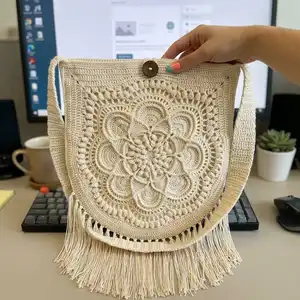
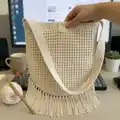
Make a stylish Delilah Boho Bag with a textured mandala panel, fringe and a sewn lining. This pattern guides you through each round, blocking, joining panels, sewing the lining and attaching the strap and fringe. You will enjoy the crochet texture and finishing techniques to produce a durable, beautiful bag. Perfect for gifting or taking out on everyday adventures.
Progress Tracker
0% Complete
— Panel Pattern :
Round 1 :
Magic ring. Ch1, 16sc into ring, slst in sc (16 sc)
Round 2 :
Ch1, *sc, ch2, skip 1 sc* x 8, slst in sc, slst in ch2 sp (8 sc, 8 ch2 sps)
Round 3 :
See Special Stitches for PC stitch. (PC, ch2) in each ch2 sp, slst in PC, slst in ch2 sp (8 PC, 8 ch2 sps)
Round 4 :
(PC, ch3, PC) in each ch2 sp, slst in PC, slst in ch2 sp (16 PC, 8 ch2 sps)
Round 5 :
*(PC, ch5, PC) in ch3 sp, dc between next 2 PC* x 8, slst in PC, slst in ch5 sp (16 PC, 8 dc, 8 ch5 sps)
Round 6 :
*9dc in ch5 sp, FPtr around dc* x 8, slst in dc (72 dc, 8 FPtr)
Round 7 :
Ch1, *BPsc x 9, (FPtr, ch3, FPtr) around FPtr* x 8, slst in BPsc (Stitch counts are per side for rounds 7-17: 9 BLsc, 2 FPtr, 1 ch3 sp)
Round 8 :
Ch1, *sc x 9, FPdc around FPtr, 5dc in ch3 sp, FPdc around FPtr* x 8, slst in sc, slst in next sc (9 sc, 2 FPdc, 5 dc)
Round 9 :
Ch1, *sc x 7, skip 1 sc, FPdc, 2BLdc x 5, FPdc, skip 1 sc* x 8, slst in sc, slst in next sc (7 sc, 2 FPdc, 10 BLdc)
Round 10 :
Ch1, *sc x 5, skip 1 sc, FPdc, [2dc, dc] x 5, FPdc, skip 1 sc* x 8, slst in sc, slst in next sc (5 sc, 2 FPdc, 15 dc)
Round 11 :
Ch1, *sc x 3, skip 1 sc, FPdc, [dc x 2, 2dc] x 5, FPdc, skip 1 sc* x 8, slst in sc, slst in next sc (3 sc, 2 FPdc, 20 dc)
Round 12 :
Ch1, *sc, skip 1 sc, FPdc, BPsc x 20, FPdc, skip 1 sc* x 8, slst in sc, slst in FPdc, slst in BPsc (1 sc, 2 FPdc, 20 BPsc)
Round 13 :
*dc x 20, FPdc2tog using next 2 FPdc (skipping sc)* x 8, slst in dc, slst in next 3 dc (20 dc, 1 FPdc2tog)
Round 14 :
Replace the first BPdc of the round with (BPsc, ch2). Ch1, *[BPdc, ch1] x 14, BPdc6tog using next 6 dc (skipping dc2tog), ch1* x 8, slst in top ch2, slst in ch1 space (14 BPdc, 1 BPdc6tog, 15 ch1 sps)
Round 15 :
Mark the 3rd sc in each set. Ch1, *sc in ch1 sp, 2sc in next 11 ch1 sps, sc in ch1 sp, skip BPdc, skip ch1 sp, skip BPdc6tog, skip ch1 sp, skip BPdc* x 8, slst in sc, slst in next (24 sc)
Round 16 :
*[dc, ch2, skip 1 sc] x 9, dc2tog using next sc and next marked stitch, ch2* x 8, replace last ch2 with dc in first dc (9 dc, 10 ch2 sps, 1 dc2tog)
Round 17 :
First PC goes into the sp created by the joining dc. Note that there is no chain space between the 2 PC either side of the dc2tog. *[PC in ch2 sp, ch3] x 9, PC in ch2 sp, skip dc2tog* x 8, slst in PC. Fasten off. (10 PC, 9 ch3 spaces)
Round 18 :
Attach yarn to the 5th space of any 'petal'. There is no ch3 space between the 2 PC either side of the dc2tog. Skip all PC. I have broken this round down into steps to make it easier to understand. 3dc in next 6 ch3 sps (photo 18a), *3hdc in next ch3 sp, 3sc in next 5 ch3 sps, 3hdc in next ch3 sp, 3dc in next 2 ch3 sps* x 5 (photo 18b), 3dc in next 3 ch3 sps, (3dc, ch2, 3dc) in next ch3 space (photo 18c), 3dc in next 5 ch3 sps, 3hdc in next ch3 sp, 3sc in next 5 ch3 sps, 3hdc in next ch3 sp, 3sc in first ch3 sp, ch1, sc in first dc (counts as ch2 sp) (photo 18e) (Total stitch counts for rounds 18-21: 96 dc, 36 hdc, 90 sc, 2 ch2 sps)
Round 19 :
3dc into space created by joining sc, dc x 18, hdc x 3, sc x 15, hdc x 3, dc x 6, hdc x 3, dc x 3, (3dc, ch2, 3dc) in ch2 space, dc x 15, hdc x 6, sc x 15, hdc x 3, dc x 18, 3dc in first space, ch1, sc in first dc (102 dc, 42 hdc, 90 sc, 2 ch2 sps)
Round 20 :
3dc into space created by joining sc, dc x 21, hdc x 3, sc x 15, hdc x 3, dc x 87, hdc x 3, sc x 15, hdc x 3, dc x 21, (3dc, ch2, 3dc) in ch2 space, dc x 18, hdc x 3, sc x 21, hdc x 3, dc x 18, 3dc into first space, ch1, sc in first dc (177 dc, 18 hdc, 51 sc, 2 sps)
Round 21 :
3dc in sp created by joining sc (mark first dc), dc x 177, 5dc in ch2 sp (mark 3rd dc), dc x 69, 2dc in first sp, slst in dc. Fasten off. (256 dc)
Info :
Repeat the pattern for the second panel then block both panels to the same size.
— Blocking :
Info :
Blocking will give a neat, flat, even look to your project while making it easier to keep the correct shape. You can dip the project in cold water or spray with clean water, squeeze gently to remove excess, pin to desired shape on blocking boards or foam mats and allow to dry completely. The sample panels were blocked to 32cm x 32cm (12.6in x 12.6in).
— Joining the panels together :
Info :
With the wrong sides of the panels facing each other, and the corners aligned, attach the yarn to the left-hand marked stitches of both panels. Ch1, sc in corresponding stitches of both panels of the bag all the way around the curved edge, stopping at the right-hand corner marked stitch. 183 sc. Do not fasten off, continue on to top edge.
— Top Edge :
Round 1 :
Mark the first st of each round. Ch1, sc x 73 starting with the next dc, sc in the first sc of the joining row, sc x 37, ch20 (button loop), sc x 36, sc in the last sc of the joining row (148 sc, 1 ch20)
Round 2 :
Sc x 148 (moving the button loop to the outside of the bag) (148 sc)
Round 3 :
Sc x 143 (finishing with 5 stitches left). Do not fasten off, continue on to the strap. (143 sc)
— Strap :
Row 1 :
Ch2 at the start of the row does not count as a stitch. Ch2, dc in same stitch as last sc, dc x 11, turn (12 dc)
Rows 2-61 :
Ch2, dc in first dc, dc x 11, skip ch2, turn. Approximately 60cm (24in) long. With no twists in the strap, place the right side of the strap against the right side of the bag. Ch1, slst the strap to the bag with 6 slst either side of the seam. Fasten off and weave in the ends.
— Lining :
Item Name (P1) :
Basic sewing knowledge assumed. Supplies: crochet bag, paper (bigger than bag), pencil, ruler, scissors, pins, lining fabric, thread to match, sewing machine. Measure bag width (w) and height (h). Fabric width needs to be twice the bag width plus 10cm (4in). Fabric length needs to be bag height plus 5cm (2in). If unsure, make the paper pattern first.
Item Name (P1) :
1. Fold the strap to the back of the bag. Place the bag in the centre of the paper and press flat with your hands. Mark the top edge on both sides where the strap joins the bag and draw around the curve. 2. Remove the bag and draw a straight line joining the marks at the top edge. 3. Add 2cm above the red line and 1cm around the curved edge. 4. Fold the pattern in half sideways and cut through both layers along the grainline to create a symmetrical pattern. Draw a grainline along the fold.
Item Name (P1) :
5. Pin the pattern onto fabric with the selvedge parallel to the grainline. If fabric is doubled you will get two pieces in one cut; otherwise cut two pieces. 6. With right sides facing, sew around the curved edge with 1cm (0.4in) seam allowance. 7. Top stitch the seam. 8. Fold the top edge over to the wrong side by 1cm (0.4in) then again by another 1cm (0.4in) and sew close to the first fold. 9. Fold the button loop down and secure it out of the way. 10. Place the lining inside the bag with right side facing inwards and side seams aligned. Pin the lining to the bag just below the top edge and sew close to the fold of the lining, being careful not to sew the button loop or straps. Finish by trimming any loose threads.
— Fringe :
Info :
Cut 135 strands of yarn at 30cm (12in) each. This makes 27 tassels with 5 strands each = 135 strands. Attach the first tassel to the 53rd sc of the joining row and then in every 3rd stitch around the bottom curve to make 27 tassels total. Iron the fringe and trim ends as needed.
Item Name (P1) :
Attach tassels: 1. Fold 5 strands in half. 2. Place a hook through the indicated stitch from back to front. 3. Place folded end of strands over the hook and pull through the stitch. 4. Yarn over with the strands. 5. Pull through the stitch and tighten. Repeat in every 3rd stitch around the bottom curve. There should be 27 tassels.
This Delilah Boho Bag pattern brings together textured crochet rounds, front and back post stitch details, popcorn stitches and a gorgeous fringe finish. It includes full instructions for blocking, joining, working the top edge and making a comfortable strap, plus a step-by-step lining tutorial. Whether for yourself or as a handmade gift, this bag is a delightful project that blends function with boho style. 🧶✨