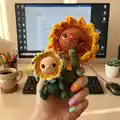
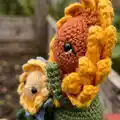
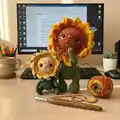
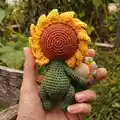
🧢 Beautiful ✨ Detailed πŸ’ Adorable

Baby Sunflower Amigurumi Pattern

Baby Sunflower Amigurumi Pattern
4.8β˜… Rating
5-7 Hours Time Needed
3.6K Made This
βœ‚οΈ

Intermediate Level

Ideal for those with basic crochet experience, featuring slightly more advanced stitches and techniques to expand your skills.

⏱️

Weekend Treat

Takes 5-7 hours, making it an enjoyable project to finish over a couple of days.

🧸

Cute Companion

An adorable friend to cherish, handcrafted with love to bring comfort and joy for years to come.

About This Baby Sunflower Amigurumi Pattern

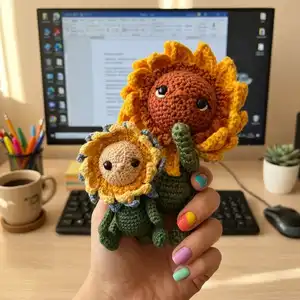
This pattern creates a sweet Baby Sunflower amigurumi with a round face, layered petals and a small cuddly body. You will crochet the head, petals, body, legs and arms, and finish with embroidery and thread-joining techniques. The pattern includes clear step-by-step photos and helpful tips to make assembly easy and neat.

Baby Sunflower Amigurumi Pattern crochet pattern - detailed view of completed project

Perfect for gifting or display, this sunflower is worked mainly in continuous spirals and uses simple shaping techniques. Detailed instructions for petals and thread-joining ensure a polished final toy.

Why You'll Love This Baby Sunflower Amigurumi Pattern

I absolutely love this pattern because it captures the charm of a sunflower in a tiny, huggable amigurumi. I enjoy how the layered petals add so much personality with simple stitches, and the construction lets you see your work come together quickly. Working the petals and back-loop rows is satisfying and gives a lovely 3D effect that I always admire. I hope you feel the same joy making it as I did designing and testing every step.

Baby Sunflower Amigurumi Pattern step 1 - construction progress Baby Sunflower Amigurumi Pattern step 2 - assembly progress Baby Sunflower Amigurumi Pattern step 3 - details and accessories Baby Sunflower Amigurumi Pattern step 4 - final assembly and finishing

Switch Things Up

I love how easy it is to customize this Baby Sunflower pattern by changing colors; try pastel tones for a softer, baby-safe look or bold oranges for a sunset sunflower.

You can make the toy larger or smaller by changing yarn weight and hook size; use a thicker yarn and larger hook for a cuddly, chunky version or fine thread and a tiny hook for a delicate miniature.

I often switch the petal colors to create seasonal versionsβ€”orange and brown for autumn, pale pink for a whimsical variant, or blue highlights for a patriotic or themed sunflower.

Try adding a tiny removable scarf, hat or tiny crocheted props to change the personality; small accessories are quick to crochet and make great gift variants.

For more poseability, I sometimes insert a short piece of thin wire into the arms so they can be positioned; make sure to cover wire ends and secure them well inside the stuffing.

If you want a keychain, reduce the size using lace cotton and a 0.75 mm hook, and attach a sturdy keyring before stuffing the body fully.

I like to experiment with different eye types: safety eyes, embroidered eyes or beadsβ€”each gives a different expression and suit different recipients (children vs. collectors).

Try embroidering freckles, blushing cheeks with a little yarn or fabric paint, or tiny stitched eyebrows to change facial expression and character.

To make a family set, vary sizes and colors so each sunflower has unique traits; grouping them on a shelf or gift box looks delightful and cohesive.

When gifting, consider sewing a small felt pocket on the back to insert a message or tiny treat; it adds a sweet, personal touch and makes the toy extra special.

Common Mistakes & How to Fix Them

βœ— Skipping the stitch marker when working in continuous spirals leads to lost rounds; always place a marker at the beginning of your round and move it each round to keep track. βœ— Not stuffing gradually creates lumps and an odd shape; stuff little by little and shape as you go to maintain smooth curves and uniform firmness. βœ— Using a different hook size without checking gauge results in incorrect finished size; try a swatch first and adjust hook size to match the sample measurements. βœ— Pulling yarn too tightly on decreases flattens the piece and changes proportions; use consistent moderate tension and practice the invisible decrease technique as described to keep neat shaping.

Baby Sunflower Amigurumi Pattern

Make a delightful Baby Sunflower amigurumi that brings a touch of sunshine to your day. This pattern guides you step-by-step through crocheting the head, petals, body, arms, legs and assembly so you can create a charming little sunflower companion. With clear photos and tips included, you will enjoy bringing this tiny character to life.

Intermediate 5-7 Hours

Materials Needed for Baby Sunflower Amigurumi Pattern

β€” Main Fabric

  • 01
    Sport weight yarn (Fine yarn) or Fingering (super fine) for 100% cotton yarn
  • 02
    Green yarn - approx. 30g (Schachenmayr Catania 0414 - moose suggested)
  • 03
    Brown yarn - approx. 15g (Scheepjes Catona brown 388 - rust suggested)
  • 04
    Yellow yarn - approx. 10g (Schachenmayr Catania 0208 - sonne suggested)
  • 05
    Blue yarn (optional for Ukrainian sunflower) - approx. 10g
  • 06
    Mustard yarn - a few meters (Schachenmayr Catania 0383 - zimt)
  • 07
    Black and white yarn - a few meters for eye details (Schachenmayr Catania black 0110 and white 0106)

β€” Tools Required

  • 01
    Crochet hook suitable for your yarn (pattern author used 1.75 mm)
  • 02
    Additional testing hooks: 1.5 mm and 0.75 mm for smaller/larger versions
  • 03
    Safety eyes 6 mm (2 pieces)
  • 04
    Scissors
  • 05
    Tapestry needle for weaving ends and sewing
  • 06
    Pins for assembly and positioning
  • 07
    Stitch marker (author uses a piece of yarn)
  • 08
    Polyester fiberfill stuffing
  • 09
    Stuffing tool (wooden skewers and tweezers recommended)
  • 10
    Strong thread for thread joining

Progress Tracker

0% Complete

β€” Read Me :

Info :

Decreases: In order to make an invisible decrease, insert the hook only under the FRONT loop of one stitch, then under the FRONT loop of the second stitch (p.1,2), yarn over and pull through these two front loops (p.3), yarn over and pull through two loops left on the hook (p.4).

β€” Note :

Info :

All parts are worked in continuous spirals (without slip stitch and ch), unless noted otherwise. To keep track of the rounds use a stitch marker.

β€” Arms :

Info :

Work with green yarn. Do not stuff the arms.

Round 1 :

6 sc in a MR (6)

Round 2-4 :

(3 rows) 6 sc (6)

Round 5 :

inc, 5 sc (7)

Round 6 :

3 sc in 1 stitch, 2 sc, dec, 2 sc (8)

Round 7 :

(inc, 1 sc) * 2, dec, 2 sc (9)

Round 8 :

(dec, 1 sc) * 2, 2 inc, 1 sc (9)

Round 9-11 :

(3 rows) 9 sc (9)

Round 12 :

(dec, 1 sc) * 3 (6)

Info :

Cut the yarn off leaving a tail for closing the opening. Insert the yarn tail into a needle, go under the front loops of all 6 sc (p.5), tighten the thread and weave in the yarn ends. Later we will attach the arms to the body.

β€” Legs :

Info :

Work with green yarn. Ch 5.

Round 1 :

From the 2nd ch from the hook (p.8): inc, 2 sc, 4 sc in 1 stitch, 2 sc along the other side of the chain, inc (12) Continue working in spirals.

Round 2 :

inc, 4 sc, 2 inc, 4 sc, inc (16)

Round 3 :

16 sc (16)

Round 4 :

4 sc, 4 dec, 4 sc (12)

Round 5 :

3 sc, 3 dec, 3 sc (9)

Info :

Stuff the foot.

Round 6 :

9 sc (9)

Round 7 :

(inc, 2 sc) * 3 (12)

Round 8 :

(inc, 3 sc) * 3 (15)

Round 9-10 :

(2 rows) 15 sc (15)

Round 11 :

(dec, 3 sc) * 3 (12)

Info :

Lightly stuff the top part of the leg, so that the shape of the leg is almost flat (p.9).

Round 12 :

6 dec (6)

Info :

Cut the yarn off, close the opening, weave in the yarn end. Later we will attach the legs to the body.

β€” Head :

Info :

Work with brown yarn.

Round 1 :

6 sc in a MR (6)

Round 2 :

6 inc (12)

Round 3 :

(inc, 1 sc) * 6 (18)

Round 4 :

(inc, 2 sc) * 6 (24)

Round 5 :

(inc, 3 sc) * 6 (30)

Round 6 :

(inc, 4 sc) * 6 (36)

Round 7-8 :

(2 rows) 36 sc (36)

Round 9-10 :

(2 rows) FLO 36 sc (p.10) (36)

Info :

Cut the yarn off leaving 15-20 cm and weave in the end using the "straight edge" method. Insert your needle into the 2nd stitch of the row (skip one stitch, insert the needle into the 2nd one) (p.11). Insert it into the last stitch of the row (between the front and the back loops of the stitch) (p.12). Pull the needle out, tighten the thread, and weave in the end (p.13). Turn the detail inside out, the tail of the MR should be outside (p.15).

Info :

Attach green yarn to the back loop of the last stitch of the previous row (p.17,18). Continue crocheting clockwise (p.16).

Round 11 :

BLO 36 sc (36)

Info :

Mark the back loop of the 1st stitch of 11th row, we will need it in 13th row.

Round 12 :

The whole row is crocheted FLO (watch this video before starting to crochet this row): (in one stitch: sl st, ch 2, 1 hdc, 1 dc, ch 2, sl st into the 2nd ch from hook, into the next stitch: 1 dc, 1 hdc, ch 2, sl st, into the next stitch: 1 sl st) * 12 (12 leaves) (p.19,20)

Round 13 :

Work into the BLO of 11th row (start from the loop you marked before) (p.21): 36 sc (36)

Round 14-16 :

(3 rows) 36 sc (36)

Info :

Insert the safety eyes between the 4th and 5th rows of the head. But first, make holes for the eyes to make it easier to insert them. I use a wooden skewer, insert it between the stitches and widen the hole (p.22). Attach safety eyes (p.23).

Round 17 :

(dec, 4 sc) * 6 (30)

Round 18 :

(dec, 3 sc) * 6 (24)

Info :

Start to stuff the head, add stuffing as you go.

Round 19 :

(dec, 2 sc) * 6 (18)

Round 20 :

(dec, 1 sc) * 6 (12)

Round 21 :

6 dec (6)

Info :

Cut the yarn off, close the opening, weave in the yarn end.

β€” Petals :

Info :

Watch this video before starting to crochet petals. Attach yarn of blue color (if you want a Ukrainian sunflower) or yellow color (if you want a regular sunflower) to the front loop of the last brown row (p.26,27).

Round 1 :

1 sc, ch 6 (p.28), turn, work on the wrong side of the chain (into the loops indicated in the p.28),

Round 2 :

from the 2nd ch from hook: 5 sc (p.29), sl st into the back loop of the base sc (p.30), turn,

Round 3 :

from the 2nd stitch from hook (skip sl st, work into the last sc of the previous row, p.31): 1 sc, 3 hdc, 2 sc in 1 stitch, ch 3, sl st into the 3rd loop from the hook (p.32), 1 sc into the same sc (the last stitch) (p.32), work along the other side of the chain, 1 sc, 3 hdc, 1 sc (p.33), sl st into the front loop of the base sc (p.34)

Round 4 :

2 sl st into the front loops on the head

Info :

Repeat instructions 1-4 11 more times. The first row of 12 petals is ready (p.36). If you crocheted this row with blue yarn, fasten off, and attach yellow yarn to the front loop of the next stitch (p.37). If you crocheted with yellow yarn, continue to crochet.

Info :

The 2nd row is made almost in the same way, the only difference is that you start with 4th instruction (make 2 sl st, p.38) and then make instructions 1-3. The petals of this row should close the spaces between petals of the previous row. Repeat instructions (4, 1-3) 12 times. Fasten off.

Info :

Attach yarn of mustard color to the next front loop (p.39). Ch 4 (p.40), sl st into the next stitch (p.41,42), repeat 35 more times (till the end of the row) (p.43). Cut the yarn off, weave in the end (p.44).

β€” Body :

Info :

Work with green yarn.

Round 1 :

6 sc in a MR (6)

Round 2 :

6 inc (12)

Round 3 :

(inc, 1 sc) * 6 (18)

Round 4 :

(inc, 2 sc) * 6 (24)

Round 5 :

(inc, 3 sc) * 6 (30)

Round 6 :

(inc, 4 sc) * 6 (36)

Round 7-11 :

(5 rows) 36 sc (36)

Round 12 :

14 sc, (dec, 1 sc) * 3, 13 sc (33)

Round 13 :

12 sc, (dec, 1 sc) * 3, 12 sc (30)

Round 14 :

(dec, 3 sc) * 6 (24)

Round 15 :

24 sc (24)

Round 16 :

(dec, 2 sc) * 6 (18)

Round 17-19 :

(3 rows) 18 sc (18)

Info :

Stuff the body firmly.

Info :

Cut the yarn off leaving 20-30 cm for sewing the body to the head.

β€” Assembling :

Info :

Embroider the nose using the same yarn you used for crocheting the face. Make 3-4 stitches over the MR (p.47,48).

Info :

Embroider the whites of the eyes with white yarn (p.49-51).

Info :

Embroider eyelashes with black thread following instructions (p.52-54). I use 4 ply yarn, divide it in half and embroider in 2 threads. You can also use embroidery thread.

Info :

Pull all the ends out at the back of the head, tie them together and weave in. If during embroidery some fiberfill threads were pulled out on the face, remove them using tweezers.

Info :

Fix the head on the body with pins as close to the green leaves as possible, the face should look a little upwards (p.55-57). Sew the head to the body with the thread left from crocheting the body. Grab a stitch on the head (p.58), then a stitch on the body (note, not a loop, a stitch - p.59). Add stuffing to the neck before you completely close the opening. Weave in the yarn end.

β€” Thread joining :

Info :

Count the rows from the bottom of the body. Pin the legs between rows 6 and 7 and the arm between rows 13 and 14 (p.61,62).

Info :

Use a strong thread (we will need about 50 cm for the arms and 50 cm for the legs). Grab several stitches from the inside of the leg (p.63), pull the needle through the body (p.64,65), grab several stitches on the inner side of the second leg (p.66), and pull the needle back through the body (p.67). Repeat these steps several times (2-3 will be enough), inserting the needle into the same holes and trying to grab the same stitches on the legs. Squeeze the legs a little (p.68), pull up both ends, tie them together several times and weave them in.

Info :

Attach the arms using the same method, but grab just 1-2 stitches on the arms (p.69).

Assembly Instructions

  • Embroider the nose with the same yarn used for the face, making 3-4 small stitches over the magic ring area to shape the nose.
  • Position and attach the safety eyes between the 4th and 5th rounds of the head after widening the holes with a wooden skewer; then embroider whites and eyelashes as shown.
  • Sew the head to the body using the yarn tail left from crocheting the body, grabbing a stitch on the head and a stitch (not a loop) on the body; add stuffing to the neck before closing.
  • Pin legs between body rows 6 and 7 and the arms between rows 13 and 14, then thread-join each limb by grabbing several stitches from the inside of the limb and pulling the needle through the body multiple times to secure.
  • After joining limbs, pull up both thread ends, tie them several times, and weave in securely; tuck and trim any excess threads for a neat finish.

Important Notes

  • πŸ’‘All parts are worked in continuous spirals; do not join rounds with slip stitch unless the pattern indicates otherwise.
  • πŸ’‘Use a stitch marker to mark the beginning of each round to avoid losing track of rounds when working in spirals.
  • πŸ’‘Stuff gradually and evenly; overstuffing may distort shapes while under-stuffing may leave the toy floppy.
  • πŸ’‘Pin parts in place before sewing to ensure correct placement and symmetry during assembly.

Your Baby Sunflower is ready to brighten any shelf or gift box! 🌻 Handmade with love, this little amigurumi brings sunshine to your craft projects and makes a perfect thoughtful gift. 🧢 Enjoy every stitch and let this tiny sunflower bring smiles to friends and family. ✨
You ask,

we answer.

FAQs

What size will the finished piece be?

If you use the material and crochet hook indicated in the pattern, the toy will be approximately 12 cm (4.7 inches) tall. Testing with different hooks produced sizes of 16 cm (1.5 mm hook) and 7 cm (0.75 mm hook).

Can I use different yarn weights for this pattern?

Yes, you can use different yarn weights but this will change the final size and texture; adjust your hook size accordingly and make a small test to check proportions before continuing.

Do I need prior crochet experience for this pattern?

This pattern is rated intermediate because it uses continuous spirals, FLO/BLO techniques and invisible decreases; basic amigurumi experience and familiarity with these techniques are recommended.

How long does this project typically take to complete?

Most crocheters complete this project in 5-7 hours, depending on experience and whether you make small adjustments or practice the petal construction.